
 CONTENT IN A NUTSHELL CONTENT IN A NUTSHELL |
PLACE IN THE
CURRICULUM |
CENTRAL CONCEPTS |
||||
| RELATED CONCEPTS |
RELATED SKILLS |
PERFORMANCE
OBJECTIVES |
The planet earth is composed of three distinct regions, the core, the mantle, and the crust (Figure 1). The core is believed to be mainly a sphere of iron and nickel which extends about 3500 km from the center. There is an inner core that appears to be solid, and an outer core that is molten. The mantle is thought to be mostly the silicate mineral olivine, (Fe,Mg)2 SiO 4 . This extends another 3000 km. The region about which we know the most, the crust, has a thickness of 5 to 100 km. It is composed of the hydrosphere and the lithosphere. The lithosphere, which is hard, brittle, and relatively cool, rides on the upper portion of the mantle, the asthenosphere, which is hot, plastic, and semiliquid. Heat and pressure only partially explain the existence of the semiliquid layer between two solid layers. A jelly sandwich is an effective analogy.
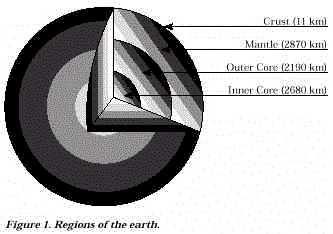
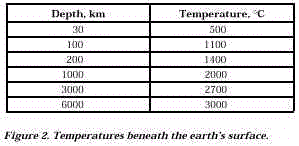
Figure 2 shows how the temperature of the regions varies. The temperature increases from the crust to the inner core.
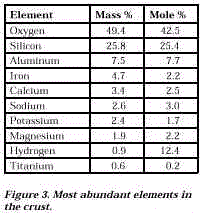
The ten most abundant elements in the crust are shown in Figure 3. Oxygen is the most abundant nonmetal and aluminum is the most abundant metal.
Oxygen, the most abundant element, comprises about 20% of the atmosphere, but most of the oxygen in the crust is found in the lithosphere not as an element, but combined with other elements. The second most abundant element, silicon, is found combined with oxygen in silicon dioxide and over a thousand different silicates. The numerous variations are due to the ability of silicon to bond to oxygen to form SiO 4 4– tetrahedra and the ability of these tetrahedra to join by sharing a common oxygen.
Silicon’s position in the mineral kingdom is analogous to that of carbon in the animal and vegetable kingdoms. Silicon, like carbon, is tetravalent, and forms various giant molecules and polymers. Unlike carbon, however, silicon cannot form endless bonds with its own atoms and has limited ability to form multiple bonds. The strikingly different properties of SiO 2 (s) and CO 2 (g) illustrate this dissimilarity. Silicon dioxide is a network of joined tetrahedral SiO 4 units, while carbon dioxide consists of discrete molecules, O=C=O. The silicates also contain the SiO 4 units joined to form chains, layers, sheets, or three-dimensional arrangements. Synthetic silicone polymers also contain Si–O bonds, as well as carbon-containing organic groups.
The uses of silicon compounds are related to their thermal stability and inertness. The bond energy of the Si–O bond is 430ÊkJ/mol compared to 190ÊkJ/mol for Si–Si and 340 kJ/mol for C–C. Although many elements are found as silicates, silicates are not generally useful as sources of these elements because of the difficulty of extracting them. Silicates are primarily used with only small modifications of their structure—as glasses, ceramics, and cement. Because of the strength of the Si–O bond, synthetic silicones—(R 2 SiO)n with R = CH 3 , C 2 H 5 , C 6 H 5 —are used as lubricants, waxes, greases, and water repellents.
Minerals are inorganic solids of definite composition found in the crust. They include the silicate minerals as well as uncombined elements (e.g., Cu, Ag, Au, and S) and compounds such as oxides, carbonates, sulfates, sulfides, halides, and phosphates. Iron, the fourth most abundant element in the earth’s crust, is of great economic importance as a structural material. The major sources of iron are ores containing 30–40% iron in the form of hematite, Fe 2 O 3 , or magnetite, Fe 3 O 4 . Aluminum is also of considerable economic importance. It is chiefly obtained from bauxite, a mixture of alumina, Al 2 O 3 , with major impurities of Fe 2 O 3 and SiO 2 . After separation from these impurities the alumina is reduced by electrochemical means. Calcium, the fifth most abundant element is found as limestone, marble, and chalk (all varieties of CaCO 3 ), anhydrite, CaSO 4 , gypsum, CaSO 4 . 2H 2 O, fluorite, CaF 2 , and apatite, Ca(F,Cl)2 . 3Ca 3 (PO 4 ) 2 . Some of these materials (limestone, marble, and gypsum) are used without modification for structural purposes. Modifications and combinations with silicates produce plaster of Paris, cement, ceramics, and bricks.
Although the earth seems permanent to us, it is constantly changing. Movement of the solid lithosphere on the plastic asthenosphere causes cataclysmic changes such as earthquakes and volcanoes. The exposure of the rocks at the surface to atmospheric gases, water, and temperature changes also brings about significant alteration of the crust. These changes are called weathering and ultimately result in converting rocks to soil. The geologist divides weathering into mechanical and chemical. Some chemists might argue that even mechanical weathering is primarily chemical since most of the mechanical changes are brought about by the actions of water. Freezing water causes rocks to break and chip. Water dissolves minerals and transports them to distant locations and deposits them. Mineral ore deposits are created when water concentrates minerals in a small region. Chemical changes result when water, oxygen, and carbon dioxide react with rocks, producing new compounds and often causing rocks to crumble. Carbon dioxide dissolves in water, producing an acidic solution that reacts with some minerals. These processes have been active for millions of years and result in a land surface covered with rock fragments.
If this module is taught as a separate unit, the student should have some background in equilibrium, chemical bonding, solutions, and molecular geometry. You may wish to use one or more of these activities to apply the chemistry in other modules.
After completing their study of rocks, minerals and gems, students should be able to: