
 WITHIN
CHEMISTRY WITHIN
CHEMISTRY |
| BETWEEN CHEMISTRY AND OTHER DISCIPLINES |
| TO THE CONTEMPORARY WORLD |
Chemical bonding. The study of rocks and minerals reinforces the importance of structure and geometry in determining properties of network substances.
Equilibrium. Equilibrium can be reviewed through study of the crystallization process.
Solubility and precipitation. Growing crystals, particularly in gels, is a vivid illustration of properties of solutions and precipitation phenomena.
Transition elements. Transition elements are frequently responsible for color that makes minerals valuable as gemstones.
BETWEEN CHEMISTRY AND OTHER DISCIPLINES
There is a strong connection between the topic of this module and geology.
Gemstones
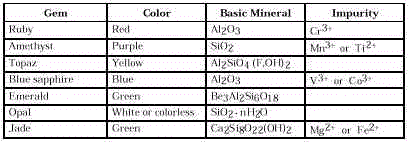
Gemstones are minerals valued for their beauty including color, transparency, and luster or brilliance. Color is sometimes dependent on crystal structure and bond type, but it most frequently is related to chemical composition. Color is often characterized by the presence of transition elements either directly related to the composition, such as the blue or green of copper-containing minerals or as impurities that impart color to colorless minerals such as quartz. The basic structures of minerals are frequently silicon oxides, which have already been discussed, or a form of Al 2 O 3 , corundum. It is a hexagonal closest packed arrangement of O 2– ions with Al 3+ ions in two-thirds of the octahedral holes. The oxide ions are stacked in the A-B-A-B arrangement, and the aluminum ions fall into those holes that allow them to touch six oxide anions.
Examples of the gemstones formed are shown below.
Personal
(including careers)Study of rocks, minerals and gems will be interesting to those who are interested in careers as geochemists as well as those who pursue "rock hounding" as a hobby. One area that will almost certainly be emphasized in the future is materials science—extracting and modifying earth materials for practical uses (see Materials
Science module).Community
Field Trips
In areas where possible, a trip to a working mine would be valuable. Many cities have rock and mineral displays in museums.
Knowledgeable Individuals
The earth science or geology teacher or local college professor Rock hobbyists Members of the local geological society Lapidarist—a collector or dealer in gems
Other